









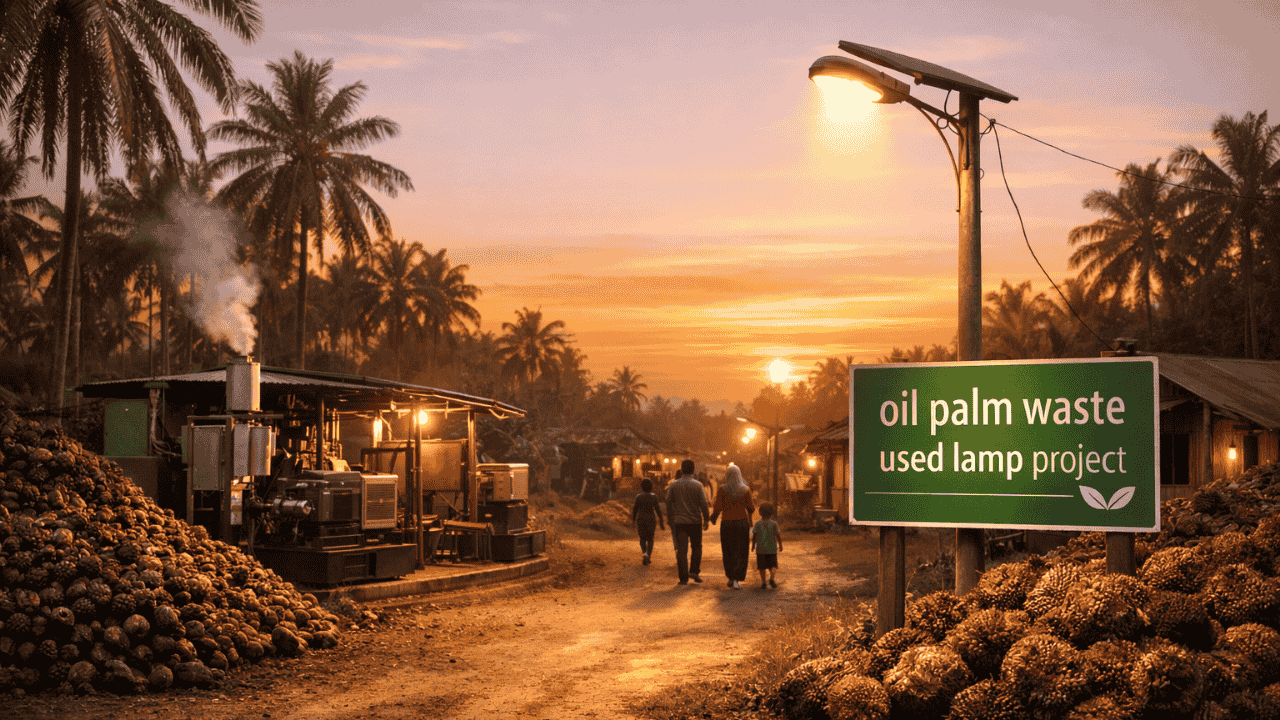
The oil palm industry generates massive amounts of agricultural residue every year. In countries where palm oil production drives the rural economy, waste piles up just as quickly as profits. Empty fruit bunches, palm kernel shells, fibers, and effluent accumulate around mills, often burned or dumped. At the same time, many rural communities still struggle with limited or expensive electricity access. The oil palm waste used lamp project brings these two realities together and offers a practical solution. Instead of treating palm waste as a disposal problem, it converts it into a local energy source that powers lamps, street lights, and small lighting systems.
Understanding the Scale of Oil Palm Waste
Palm oil production leaves behind far more waste than finished product. For every one ton of palm oil extracted, roughly four tons of biomass waste are produced. This includes empty fruit bunches, palm kernel shells, mesocarp fiber, palm fronds, trunks, and palm oil mill effluent.
Malaysia and Indonesia, the world’s largest palm oil producers, generate more than 100 million tons of palm biomass waste each year. A significant portion of this waste is either openly burned or left to decompose. Both practices contribute to environmental pollution. Decomposition releases methane, a greenhouse gas far more potent than carbon dioxide, while burning creates air quality problems.
The oil palm waste used lamp project takes advantage of this overlooked resource. Instead of allowing waste to sit idle or become a liability, it transforms it into fuel for lighting systems.
Energy Potential Hidden in Palm Biomass
Palm waste is not just agricultural residue. It contains substantial energy value. Research shows that palm kernel shell briquettes can reach a calorific value of around 25.86 megajoules per kilogram. Empty fruit bunch biomass can provide up to 23.6 megajoules per kilogram. Palm shells average around 22 megajoules per kilogram.
To put that into perspective, these numbers are close to the energy content of certain grades of coal. That means palm waste can serve as a strong alternative biomass fuel.
From an energy production standpoint:
- One ton of palm kernel shells can generate around 1,260 kilowatt-hours of electricity after proper conversion.
- Small-scale systems processing 15 tons of palm kernel shells per day can generate about 180 kilowatt-hours daily for local lighting needs.
- Projects of this size have powered between 25 to 30 street lights per installation unit.
These figures show that the oil palm waste used lamp project is not just an idea for environmental awareness campaigns. It is technically viable and capable of producing measurable output.
How the Oil Palm Waste Used Lamp Project Works
The oil palm waste used lamp project follows a straightforward process that converts biomass into usable electricity for lighting.
Waste Collection and Preparation
The process begins at palm oil mills. Waste materials such as palm kernel shells, empty fruit bunches, and fibers are collected and sorted. These materials are then dried to reduce moisture content, which improves combustion efficiency.
In some systems, the biomass is compressed into briquettes or converted into charcoal. In others, it is fed directly into gasification units.
Biomass Conversion
There are two main conversion methods used in the oil palm waste used lamp project:
- Direct combustion, where biomass is burned to produce heat.
- Gasification, where biomass is partially oxidized to produce a combustible gas mixture.
Gasification is often preferred for small-scale energy systems because it produces cleaner fuel gas that can power generators more efficiently.
Electricity Generation
The heat or gas produced during conversion drives a turbine or internal combustion engine connected to a generator. The generator then produces electricity.
This electricity is directed into:
- Street lighting systems
- Community lamp posts
- Small village micro-grids
- Off-grid household lighting
Through this process, the oil palm waste used lamp project creates a closed-loop system that uses local waste to meet local energy needs.
Environmental Benefits of the Oil Palm Waste Used Lamp Project
One of the strongest arguments for the oil palm waste used lamp project is its environmental impact.
Reduction of Waste Accumulation
Instead of stockpiling empty fruit bunches and shells, mills can channel them into energy production. One documented project reduced around 5,475 tons of palm waste annually by using it for power generation.
Lower Carbon Emissions
A properly managed biomass energy system can significantly reduce greenhouse gas emissions compared to fossil fuel alternatives. In one case study, the project helped cut approximately 8,200 tons of carbon dioxide emissions per year.
When biomass replaces diesel generators or kerosene lamps in rural areas, emissions drop further. The oil palm waste used lamp project therefore supports climate mitigation goals while meeting energy demand.
Supporting Circular Economy Principles
The palm oil industry often faces criticism for environmental damage. However, initiatives like the oil palm waste used lamp project show how waste streams can be integrated into a circular model. Agricultural by-products become inputs for energy production instead of environmental burdens.
Economic Impact on Rural Communities
Beyond environmental gains, the oil palm waste used lamp project creates economic opportunities.
Added Value to Waste Materials
Palm kernel shells can be sold at prices ranging from 15 to 30 dollars per ton, while empty fruit bunches may fetch 8 to 18 dollars per ton. When used for energy production, these materials shift from disposal cost to income source.
Palm mills save on waste management expenses. Communities benefit from affordable electricity.
Job Creation
The oil palm waste used lamp project requires labor for:
- Biomass collection
- Processing and drying
- System maintenance
- Electrical distribution
These activities create employment opportunities within rural regions where jobs are often limited.
Affordable Lighting Access
Many off-grid villages rely on kerosene lamps, which are both expensive and hazardous. Locally generated electricity from palm waste can provide:
- Safer indoor lighting
- Street lights for public safety
- Extended hours for education and small businesses
Lighting improves productivity, education outcomes, and community security.
Real-World Application of the Oil Palm Waste Used Lamp Project
Field implementations demonstrate that the oil palm waste used lamp project is not confined to theory.
In one operational example:
- 15 tons of palm kernel shells were processed daily.
- Around 180 kilowatt-hours of electricity were generated.
- 25 to 30 street lights were powered per system.
- Over 5,000 tons of waste were diverted from disposal annually.
- Thousands of tons of carbon emissions were avoided.
These figures provide practical evidence that small-scale biomass systems can deliver consistent lighting solutions.
Technical and Operational Challenges
No project is without limitations, and the oil palm waste used lamp project also faces hurdles.
Initial Setup Costs
Biomass gasifiers, generators, and distribution systems require upfront investment. For small communities, funding can be a barrier.
Logistics and Supply Chain
Waste must be transported from mills to processing units. Poor road infrastructure can increase costs.
Maintenance and Training
Gasification systems require skilled operators. Without proper training, performance declines. Ongoing maintenance is essential for long-term success.
Despite these challenges, the oil palm waste used lamp project remains attractive because raw materials are abundant and locally available.
Future Potential of the Oil Palm Waste Used Lamp Project
As renewable energy policies expand across Southeast Asia and other palm-producing regions, biomass energy will likely gain stronger institutional support.
The oil palm waste used lamp project could evolve into:
- Hybrid systems combining solar and biomass
- Larger micro-grids for rural electrification
- Integrated waste-to-energy plants serving both lighting and small industries
With continued research and investment, efficiency improvements may further increase energy output per ton of waste.
The key advantage remains clear: the fuel source is already there. It does not require new plantations or additional resource extraction. It simply requires smarter management of what already exists.
Conclusion
The oil palm waste used lamp project represents a practical response to two pressing issues: agricultural waste management and rural energy access. Palm oil production creates enormous volumes of biomass residue, much of which goes unused or causes environmental harm. At the same time, many rural communities lack reliable lighting.
By converting palm kernel shells, empty fruit bunches, and fibers into electricity, the oil palm waste used lamp project turns waste into opportunity. It reduces emissions, cuts disposal costs, creates jobs, and improves safety and productivity through better lighting.
While initial costs and technical training remain challenges, the long-term benefits outweigh the barriers. With proper implementation, the oil palm waste used lamp project can serve as a model for sustainable rural development in palm-producing regions worldwide.
FAQs
- What is the oil palm waste used lamp project?
The oil palm waste used lamp project is a renewable energy initiative that converts palm oil industry waste into electricity to power lamps and street lighting systems, especially in rural or off-grid areas.
- What types of waste are used in the oil palm waste used lamp project?
Common materials include palm kernel shells, empty fruit bunches, mesocarp fiber, palm fronds, and other biomass residues generated during palm oil processing.
- How much electricity can palm waste generate?
One ton of palm kernel shells can generate approximately 1,260 kilowatt-hours of electricity after conversion, depending on system efficiency.
- Is the oil palm waste used lamp project environmentally friendly?
Yes. It reduces waste accumulation, lowers greenhouse gas emissions, and replaces fossil fuel-based lighting sources such as diesel generators and kerosene lamps.
- What are the main challenges of implementing the oil palm waste used lamp project?
Key challenges include initial setup costs, logistics for waste collection, system maintenance, and the need for trained operators to manage biomass conversion systems.